
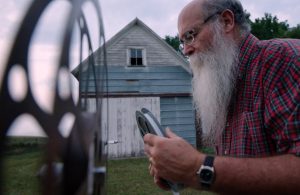
 ‘Saving Brinton’ is one of those magical gems that comes along every once in a while, a slow-burning delight that starts with an individual, the kind of guy we might have been lucky enough to encounter in our travels – a genuine, decent guy who often goes unnoticed in the let’s-make-a-deal cities – and then opens out to show how he tweaks the orbit of the planets, just a tiny glorious bit.
Michael Zahs is working his farm when we first see him, in Ainseworth Iowa. In his friendly, leisurely way, he establishes how he came by the Brinton films. William and Indiana Brinton had traveled around Iowa running projection shows (magic lantern slides, early movies and even a prototype flying machine that neglected to fly) in the 1890’s through 1911. When they died, their films went from their executor, who stowed them in the basement, to his executor to Zahs, who put them in a shed alongside his home and showed some of them every year in local shows around the area for thirty years, vainly trying to get someone to pay attention, until finally the University of Iowa recognized what he had.
What he had (film-lovers, prepare to gasp) were at least two Georges Melies films that were thought lost, several hand-tinted early color films in better shape than any the Library of Congress had previously seen, early footage of a train crossing the Brooklyn Bridge, Teddy Roosevelt riding in a parade and a Middle East market. Amazing stuff. Here’s a link to the film page, which will be updated as more films are digitized.
There’s a scene where the Library of Congress’s french film expert watches one of the Melies and exclaims ‘You want to see me faint?’
In the meantime, Michael plants his fields, buries his mother, gives history demonstrations that aren’t boring (!) to Iowa schoolchildren and a humorous presentation on cemeteries (!) to an assemblage of Iowa Amish, who trusted him enough to agree to be filmed. By the time you see it, that he’s earned their trust is not a surprise–as wonderful as the films he’s saved are, much of the film’s joy and grace comes from the opportunity it gives us to know the man.
Here’s the website again. But just go see this movie–you’ll leave with a really stupid smile plastered across your face, which is something we all need these days.
And if you live in Manhattan and can make it, go TODAY (May 18th 2018) to Cinema Village on 12th Street – the filmmakers and Michael are there all day to answer questions in their very gracious and charming way. Support good people doing good things – how many chances do you get?
 It’s on Netflix, which is where I’m spending a lot of time now. It’s in German with subtitles -if you don’t like reading on film, get over it. This is worth the effort.
 There’s several deaths and lots of conspiracies – Communists against the police, Czarist sympathizers against the Soviets, the old-aristocracy German military hierarchy against the Government, which must at least attempt to adhere to the Treaty of Versailles. Lots of shooting, wild dancing and drug-taking (opium figures prominently), a very real sense of the way people move through a crazy world just trying to survive – and a couple of items that really separate ‘Babylon Berlin’ from anything similar I’ve ever seen (though, in honesty, I’m not sure I’ve ever seen anything else quite like it).
 The other thing that’s wonderful is how this story begins as one animal and becomes another. Netflix has two seasons up so far and the first one ends by tying up the supposed mystery Rath arrived trying to solve but you’re so far beyond that mystery by the time it’s tied up, it would have been maddening if that first season had appeared on its own. It takes the full two seasons to really resolve the main storyline, which balloons into territory so much bigger. It’s like the horizons open as you move into the story, as though the filmmakers got into this world and discovered a much bigger world they fit right into – while naturally, saving a really wrenching surprise for the last few minutes.

 Me: Xerox is gone.
 It’s a snow day.
 That’s as close as anyone’s come to the nauseating, careening roller-coaster-without-brakes quality of the evening.
 The problem here was the way hardworking people who played by what they thought were the rules found themselves shoved in a corner and left to rot. Maybe someday we’ll get back to you, but don’t count on it.
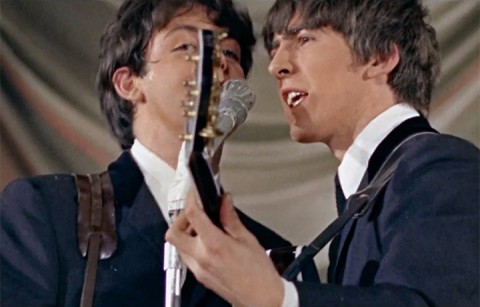 In the morning, we went to see Eight Days a Week, the Ron Howard Beatles touring history at the IFC Center in Greenwich Village. I know it’s available online but if you see it in theaters, they show the entirety of the Beatles’ Shea Stadium Concert right after (the set was less than an hour).
 And that night, after the movie, we went with friends to a Mets game. I’ve been a fan through some amazing ups and downs but nothing like this year. This team is held together by Terry Collins, gaffer’s tape and chicken wire. Maybe it’s all a mirage because they’re playing uniformly bad opposition right now but they’re on a hell of a roll anyway. Every favorite of mine from last year is either injured for the year or playing ineffectively off the bench. I’ve never been prouder as a fan.
 Elections tend to bring out the best and the worst in us citizen-spectators. The issues are, after all, about our lives – aren’t they? So while the candidates debate on TV, my opinionated friends usually carry on a debate of their own, offering sometimes-crackpot solutions and spending a lot of energy translating the national conversation into a ground-level discussion of how it really affects our lives.